Your Team Is Still Doing This Manually? These 5 Underrated Software Automation Tools Say Otherwise

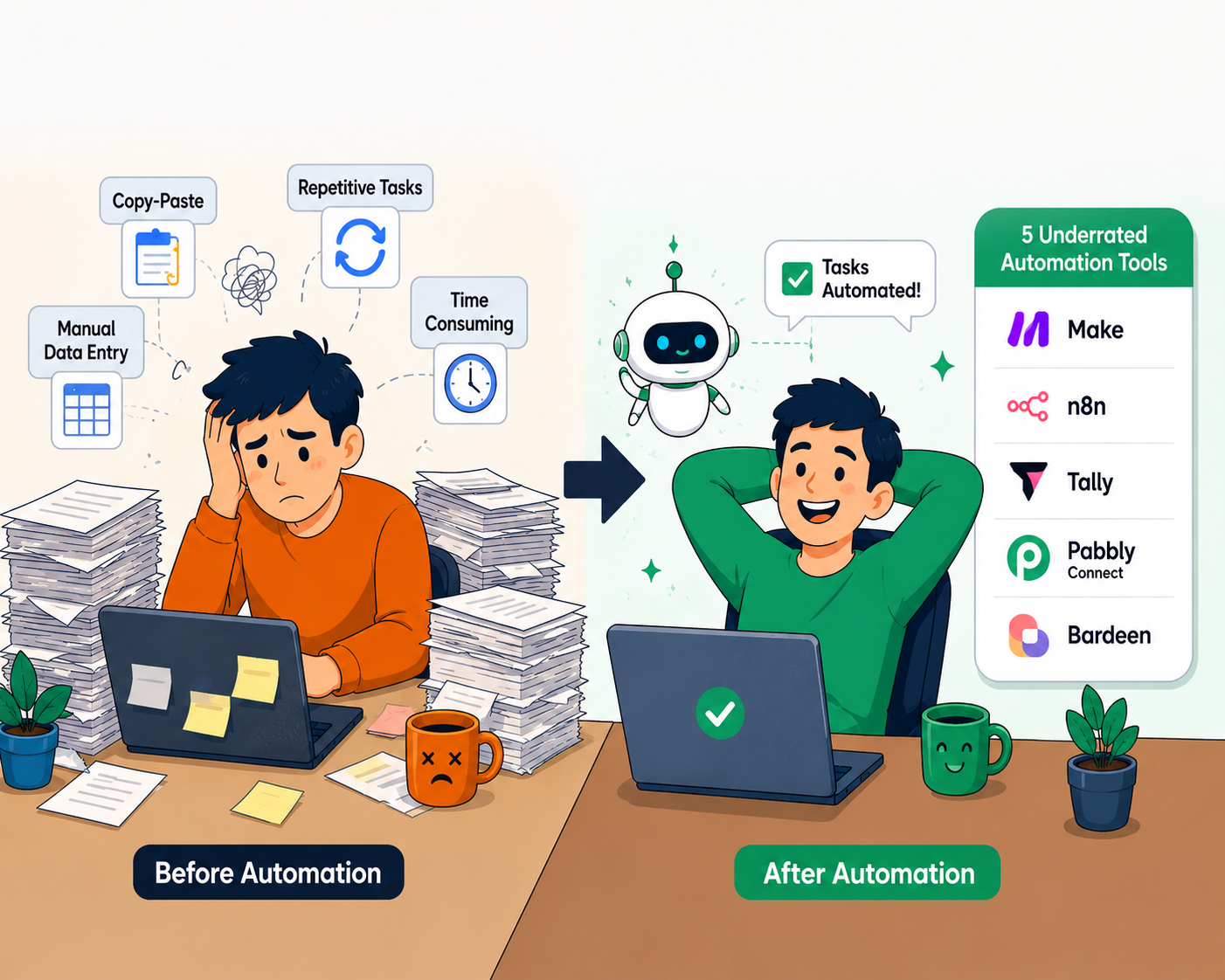
Automation has become a business necessity, but many organizations still associate it with big names like Zapier or Microsoft Power Automate. While these platforms are powerful, they are no longer the only options worth considering. A new generation of software automation tools is quietly helping businesses automate repetitive workflows, connect disconnected applications, and improve productivity—often with greater flexibility and lower costs.
The real challenge isn’t deciding whether to automate. It’s finding the right platform that fits your workflows without adding unnecessary complexity. That’s where underrated solutions are making a difference. These tools may not dominate headlines, but they are earning loyal communities because they solve real business problems efficiently.
If your team still spends hours moving data between apps, manually updating CRMs, or chasing repetitive approvals, these five software automation tools deserve a closer look.
1. n8n – Open-Source Automation Without Limits
Most automation platforms lock advanced features behind expensive pricing plans. n8n takes a different approach by giving businesses complete control over their automation workflows.
Unlike many cloud-only platforms, n8n can be self-hosted, making it an excellent choice for organizations with strict security or compliance requirements. It supports hundreds of integrations while allowing developers to build custom workflows using JavaScript whenever needed.
Businesses use n8n to automate CRM updates, synchronize customer data, process API requests, monitor systems, and connect applications that would otherwise require manual intervention.
For companies seeking flexible software automation tools, n8n offers enterprise-level capabilities without enterprise-level licensing costs.
2. Activepieces – Automation Built for Modern Teams
Open-source automation has grown rapidly, and Activepieces is emerging as one of the most promising platforms in this space.
Designed with simplicity in mind, Activepieces enables users to build visual workflows without extensive technical expertise. Teams can automate marketing campaigns, HR processes, finance approvals, internal notifications, and customer support operations through an intuitive interface.
What makes Activepieces particularly attractive is its growing ecosystem of integrations combined with transparent pricing. Businesses that want modern software automation tools without unnecessary complexity often find it easier to adopt than larger enterprise platforms.
As automation becomes accessible to non-technical teams, tools like Activepieces are gaining significant attention.
3. Windmill – Automation for Developers and Operations Teams
Not every automation platform is designed for technical users. Windmill bridges the gap between developers and business operations by combining workflow automation with scripting capabilities.
Users can build workflows using Python, TypeScript, Go, SQL, and Bash while still benefiting from a visual interface. This flexibility makes Windmill ideal for engineering teams that need automation beyond simple drag-and-drop workflows.
Organizations frequently use Windmill for infrastructure automation, scheduled reporting, database management, internal tools, and operational workflows.
Among emerging software automation tools, Windmill stands out because it combines developer flexibility with enterprise scalability.
4. Kestra – Workflow Orchestration at Scale
As businesses automate more processes, managing hundreds of workflows becomes increasingly difficult. Kestra addresses this challenge through event-driven workflow orchestration.
Rather than focusing solely on individual automations, Kestra coordinates large-scale workflows across cloud infrastructure, databases, APIs, analytics platforms, and enterprise applications.
Its declarative approach allows organizations to manage complex automation pipelines with greater reliability and visibility.
Businesses handling large volumes of operational data increasingly adopt Kestra to streamline ETL pipelines, cloud operations, scheduled tasks, and enterprise integrations.
For organizations looking beyond basic workflow builders, Kestra represents one of the most capable software automation tools available today.
5. Baserow Automation – More Than a No-Code Database
Many businesses know Baserow as an open-source alternative to Airtable, but fewer realize its growing automation capabilities.
Users can create database-driven workflows that automatically trigger notifications, update records, assign tasks, and integrate with external applications.
For project management, CRM operations, inventory tracking, and internal business processes, Baserow eliminates countless repetitive tasks while keeping data centralized.
As businesses increasingly seek affordable no-code platforms, Baserow is quietly becoming one of the most practical software automation tools for small and mid-sized organizations.
Choosing the Right Automation Platform
Selecting automation software isn’t about finding the platform with the most integrations. The best solution depends on your team’s workflows, technical expertise, scalability requirements, and security needs.
Organizations managing customer operations may prioritize CRM integrations, while engineering teams often need scripting capabilities and infrastructure automation. Businesses handling sensitive information may also prefer self-hosted platforms that provide greater control over data.
The good news is that today’s software automation tools offer far more flexibility than traditional automation platforms. Whether you’re automating simple approvals or enterprise-wide workflows, there is likely a solution designed specifically for your requirements.
Automation Is Becoming a Competitive Advantage
Businesses that automate repetitive work gain more than efficiency. They free employees to focus on innovation, customer relationships, and strategic decision-making.
Modern software automation tools reduce operational bottlenecks, improve data accuracy, accelerate response times, and create more consistent business processes across departments.
As artificial intelligence becomes increasingly integrated into automation platforms, businesses can expect future workflows to become even smarter, adapting dynamically instead of simply following predefined rules.
Organizations that begin experimenting today will be better prepared for the next generation of intelligent automation.
Final Thoughts
The automation market is evolving rapidly, but innovation isn’t limited to the biggest vendors. Many of the most exciting developments are coming from smaller platforms that prioritize flexibility, transparency, and developer-friendly design.
If your business is still relying on manual workflows, these underrated software automation tools offer an opportunity to improve productivity without investing in overly complex enterprise systems.
Sometimes the biggest productivity gains don’t come from the most popular software.
They come from discovering the right tool before everyone else does.