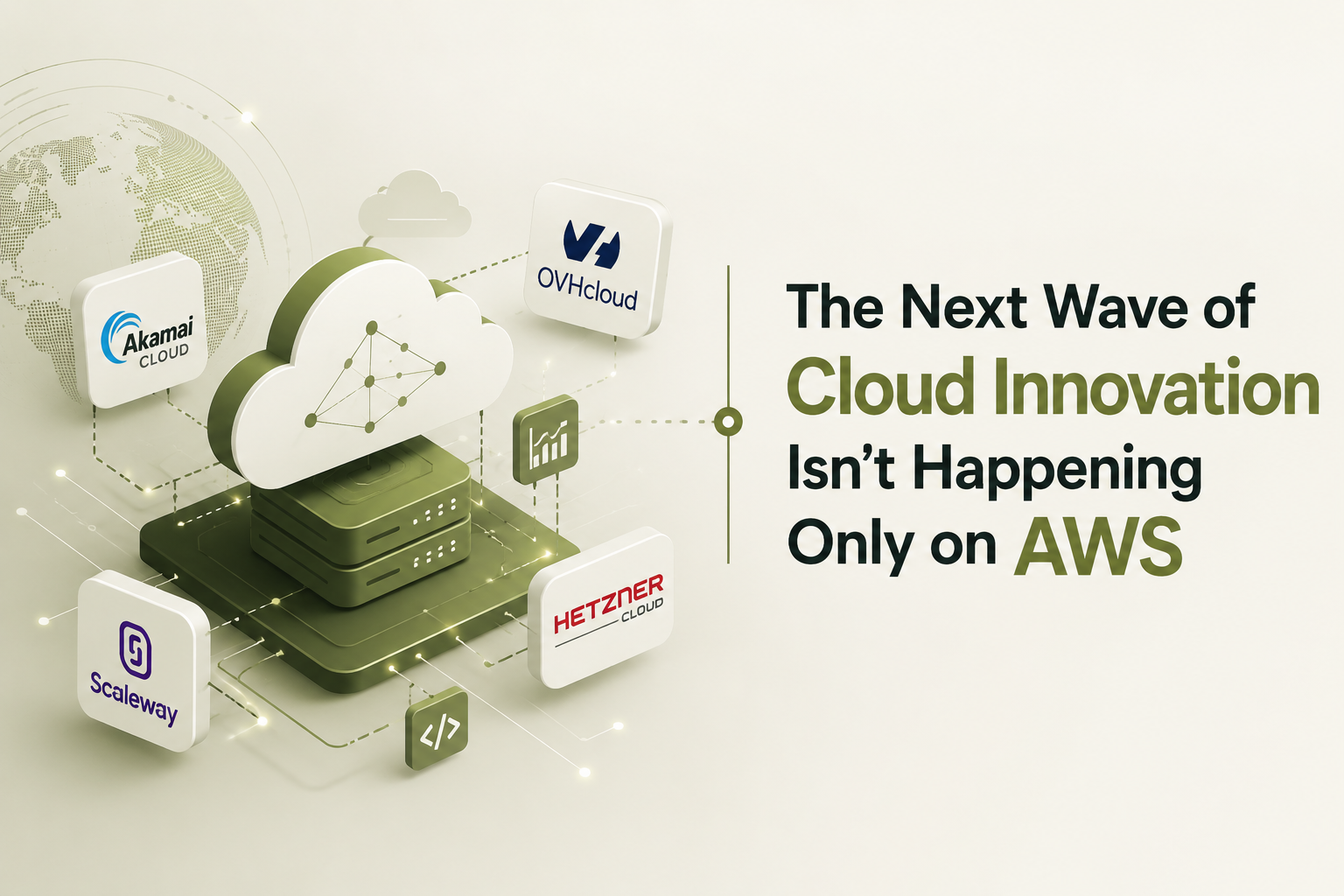
Amazon Web Services has long dominated conversations around enterprise cloud computing. For many organizations, AWS remains the default choice for launching applications, scaling infrastructure, and supporting digital transformation initiatives. Yet the cloud landscape is becoming far more diverse. As enterprises embrace AI workloads, edge computing, sovereign cloud requirements, and multi-cloud architectures, cloud architects are increasingly evaluating platforms that deliver specialized capabilities beyond the traditional hyperscalers.
This shift is being driven by more than cost considerations. Businesses want greater flexibility, transparent pricing, regional compliance, and infrastructure designed for modern cloud-native applications. At the same time, recent industry developments show growing investments in AI-ready infrastructure, GPU-powered cloud services, and regional data centers that support evolving privacy regulations. These trends are creating opportunities for several cloud providers that have quietly matured into compelling enterprise alternatives.
Akamai Cloud
Following its acquisition of Linode, Akamai has transformed its cloud offering into a platform built for modern distributed applications. Rather than competing directly with hyperscalers on every service category, Akamai Cloud focuses on delivering high-performance compute close to users through its extensive global edge network.
For cloud architects designing latency-sensitive applications, this approach is increasingly attractive. AI inference, real-time analytics, gaming, streaming platforms, and edge-native applications all benefit from infrastructure positioned closer to end users instead of relying solely on centralized cloud regions.
Recent platform enhancements have expanded Kubernetes capabilities, GPU infrastructure, and developer services while maintaining predictable pricing. Organizations looking to simplify cloud operations without sacrificing performance are beginning to view Akamai Cloud as an efficient alternative for cloud-native deployments.
The platform also aligns well with the growing enterprise trend toward distributed AI, where applications process information across multiple geographic locations to improve responsiveness and reduce network overhead.
OVHcloud
Data sovereignty has become one of the defining cloud conversations in recent years. As governments strengthen privacy regulations and organizations place greater emphasis on where data resides, European cloud providers are receiving renewed attention.
OVHcloud has positioned itself as one of the strongest alternatives for enterprises seeking regulatory confidence alongside scalable infrastructure. The platform combines public cloud services, private cloud environments, dedicated servers, and managed Kubernetes while maintaining a strong commitment to transparency and sustainable infrastructure.
Cloud architects working with multinational organizations increasingly evaluate OVHcloud for workloads that require regional hosting or strict compliance requirements. The company’s continued investment in AI infrastructure and liquid-cooling technologies also reflects broader industry demand for energy-efficient cloud operations as AI workloads continue expanding.
Rather than attempting to replicate every hyperscaler feature, OVHcloud emphasizes reliability, operational transparency, and infrastructure control—qualities that resonate with organizations building long-term cloud strategies.
Scaleway
Artificial intelligence has rapidly become one of the biggest drivers of cloud innovation, and Scaleway has responded by building infrastructure specifically designed for AI development.
The platform has expanded its portfolio with GPU-powered computing, managed Kubernetes, serverless services, object storage, and AI-focused development environments. For organizations experimenting with machine learning models or deploying generative AI applications, this combination creates an attractive development ecosystem without the complexity often associated with larger cloud providers.
Scaleway also benefits from the broader movement toward sovereign cloud services, particularly among European enterprises seeking greater control over digital infrastructure. As businesses diversify cloud investments and reduce dependence on a single provider, platforms like Scaleway are becoming important components of enterprise multi-cloud architectures.
Its developer-first experience allows engineering teams to deploy cloud-native applications quickly while maintaining flexibility for future growth, making it particularly appealing for innovation-focused organizations.
Hetzner Cloud
Among technology professionals, Hetzner Cloud has quietly earned a reputation for delivering exceptional infrastructure performance at highly competitive pricing. While it may not receive the same visibility as larger cloud providers, its simplicity and reliability have attracted a growing number of SaaS companies, software vendors, and engineering teams.
Cloud architects increasingly recommend Hetzner Cloud for Kubernetes clusters, containerized applications, development environments, internal enterprise workloads, and high-performance virtual machines. Its straightforward pricing model removes much of the unpredictability that organizations often experience with hyperscaler billing.
Current enterprise trends toward FinOps and cloud cost optimization have made this value proposition even more relevant. As businesses scrutinize infrastructure spending more carefully, platforms that deliver predictable performance without excessive operational complexity continue gaining attention.
For organizations embracing multi-cloud strategies, Hetzner Cloud often serves as a complementary platform where development, testing, disaster recovery, or specialized workloads can operate efficiently alongside larger public cloud environments.
The future of enterprise cloud computing is unlikely to be defined by a single provider. Instead, organizations are increasingly selecting cloud platforms based on workload requirements, compliance objectives, geographic presence, AI capabilities, and operational efficiency. Recent advances in generative AI, sovereign cloud initiatives, edge computing, and cloud cost optimization reinforce this transition toward more diversified cloud strategies.
For cloud architects, the opportunity lies in looking beyond familiar names and evaluating platforms that align with specific business goals. Akamai Cloud, OVHcloud, Scaleway, and Hetzner Cloud demonstrate that innovation is happening across the cloud ecosystem, not just within the largest hyperscalers. As enterprise infrastructure continues evolving, these platforms are well positioned to play an increasingly important role in shaping the next generation of cloud architecture.