Enterprise software conversations are dominated by artificial intelligence, automation, and digital transformation. Every week brings announcements about new AI assistants, autonomous agents, and productivity tools. Yet behind many successful AI initiatives lies something far less glamorous but infinitely more important an ERP platform capable of keeping business operations connected.
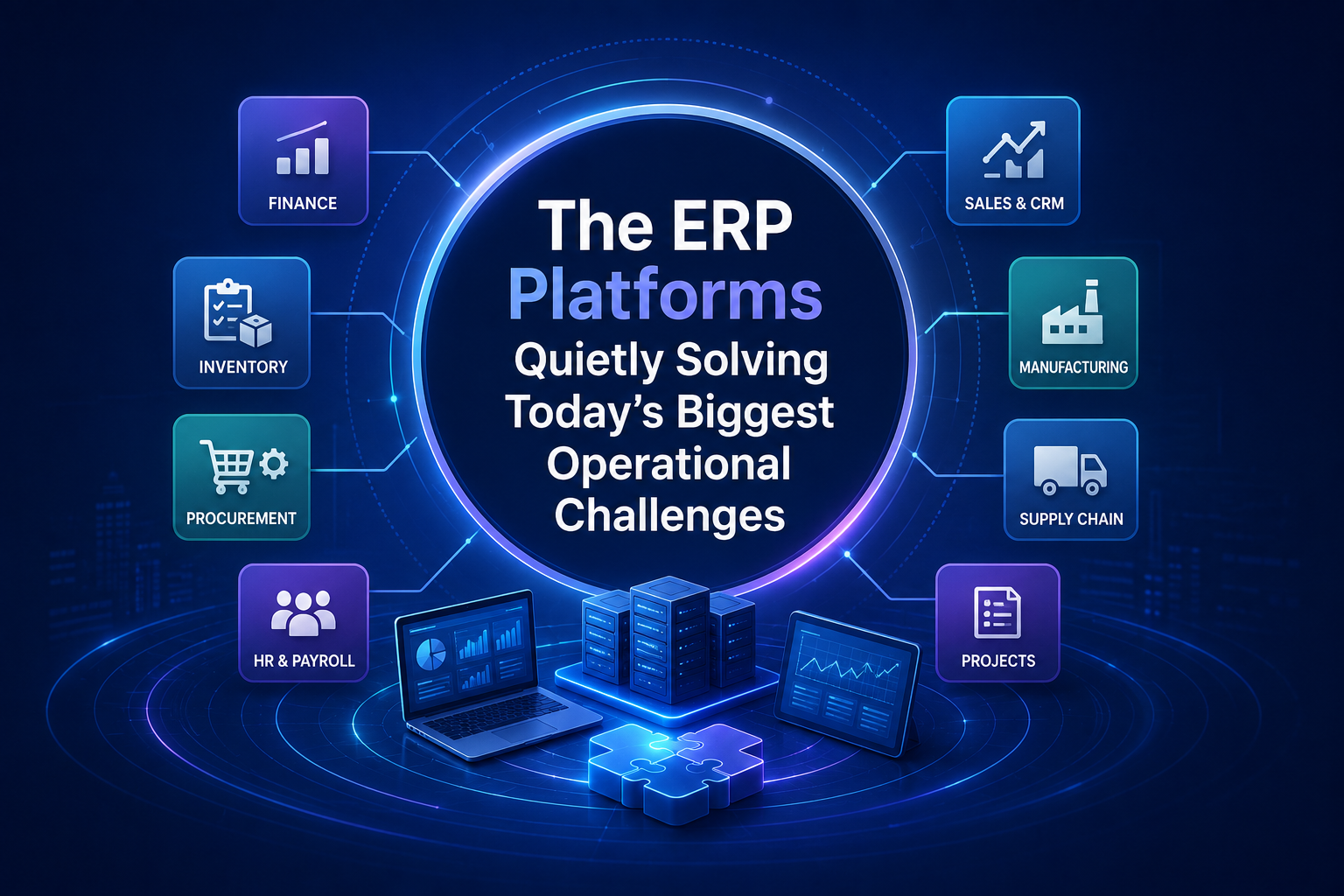
Many organizations have spent years investing in disconnected applications for finance, HR, sales, procurement, inventory, manufacturing, and customer management. While these individual systems often perform well, they frequently create operational silos that make scaling automation or AI significantly more difficult. As enterprises look to modernize, business leaders are recognizing that operational visibility is becoming just as valuable as AI itself.
This shift is changing how organizations evaluate enterprise resource planning solutions. Instead of focusing solely on brand recognition, companies are increasingly looking for cloud-native platforms, flexible customization, faster implementation, and the ability to integrate with modern AI workflows. That is creating opportunities for several ERP vendors that may not receive the same attention as industry giants but are quietly helping businesses solve complex operational challenges.
Dolibarr ERP & CRM
Not every growing business needs a highly complex enterprise platform. For many small and medium-sized organizations, simplicity can become a competitive advantage.
Dolibarr ERP & CRM has steadily built a reputation as a practical solution for businesses that want to centralize operations without introducing unnecessary complexity. Combining ERP and CRM capabilities within a single platform, Dolibarr enables organizations to manage customers, invoicing, inventory, accounting, projects, and sales through a unified environment.
As businesses continue embracing cloud-based operations and digital collaboration, lightweight ERP platforms are becoming increasingly attractive. Many organizations want software that employees can adopt quickly without lengthy implementation cycles or expensive consulting engagements. Dolibarr addresses that need by offering flexibility while remaining approachable for growing companies.
For decision-makers balancing operational efficiency with limited resources, the ability to consolidate multiple business functions into one platform can significantly reduce administrative overhead while improving visibility across the organization.
Axelor ERP
Business processes rarely fit into standardized templates anymore. Every organization develops unique workflows shaped by its customers, industry requirements, and internal operations. That reality is fueling growing interest in ERP platforms that prioritize adaptability over rigid configuration.
Axelor ERP stands out because it combines enterprise resource planning with a powerful low-code development environment. Rather than forcing organizations to redesign their operations around software limitations, the platform enables businesses to tailor workflows, automate approvals, and build custom applications without extensive coding.
The growing popularity of low-code platforms across the enterprise software market reflects a broader trend toward business agility. Companies increasingly want operational systems that evolve alongside changing customer expectations, regulatory requirements, and AI-powered processes.
For organizations pursuing continuous digital transformation instead of one-time modernization projects, Axelor provides the flexibility needed to adjust operational workflows without rebuilding their technology stack every few years.
ERPNext
Open-source software continues gaining credibility within enterprise technology discussions, particularly among organizations seeking greater control over their digital infrastructure.
ERPNext has emerged as one of the most comprehensive open-source ERP platforms available, offering integrated capabilities for finance, manufacturing, human resources, supply chain management, customer relationships, inventory, and project management. Its modular architecture allows businesses to implement functionality gradually while maintaining a unified operational foundation.
As AI adoption accelerates, businesses are placing greater importance on data accessibility and system integration. AI applications deliver better outcomes when business information exists within connected environments rather than isolated departmental systems. ERPNext supports this requirement by helping organizations create a centralized operational ecosystem that can serve as a reliable foundation for automation and intelligent decision-making.
For companies seeking long-term flexibility without becoming heavily dependent on proprietary software ecosystems, ERPNext represents an increasingly compelling option that aligns well with modern digital transformation strategies.
Acumatica
Cloud ERP has evolved beyond simply moving business software online. Today’s organizations expect enterprise platforms to support distributed teams, integrate with modern applications, and provide the operational visibility required for increasingly data-driven decisions.
Acumatica has quietly become one of the strongest contenders in the mid-market ERP space by focusing on usability, scalability, and cloud-native architecture. Its flexible licensing model and industry-specific capabilities have made it particularly attractive for manufacturing, distribution, construction, and retail organizations that require sophisticated operational management without enterprise-level complexity.
Recent enterprise technology trends show businesses placing greater emphasis on operational resilience rather than pure growth. Supply chain disruptions, changing customer expectations, and expanding AI initiatives all require organizations to make faster decisions based on accurate operational data. Acumatica supports that objective by connecting business functions while providing the flexibility needed to accommodate future expansion.
As more companies evaluate AI-powered analytics, intelligent automation, and predictive business operations, cloud-first ERP platforms like Acumatica are becoming foundational infrastructure rather than simply accounting systems.
Modern ERP is no longer defined by transaction processing alone. It is becoming the operational backbone that supports automation, AI initiatives, compliance, customer experience, and strategic decision-making across the enterprise.
The growing interest in platforms like Dolibarr ERP & CRM, Axelor ERP, ERPNext, and Acumatica reflects a broader shift in enterprise priorities. Organizations are looking beyond software size and vendor recognition toward flexibility, connectivity, and long-term adaptability. These platforms demonstrate that operational excellence does not always require the largest ERP vendor, it requires technology that aligns with the way modern businesses actually operate.
For B2B decision-makers, the ERP conversation is changing. The question is no longer which platform has the longest feature list. Instead, it is which platform can simplify operations today while providing the foundation needed for tomorrow’s AI-driven enterprise. Businesses that make that distinction early will be better positioned to respond to change, improve efficiency, and create sustainable competitive advantage in an increasingly connected digital economy.