Artificial intelligence has become a familiar part of HR technology conversations, but much of the attention still revolves around recruiting chatbots, resume screening, and automated interview scheduling. While these innovations remain important, a much bigger transformation is happening behind the scenes. Organizations are no longer asking how AI can help them hire faster—they’re asking how AI can help them understand, develop, retain, and redeploy talent already inside the business.
This shift is being driven by a combination of economic uncertainty, persistent skill shortages, hybrid work, and the rapid adoption of generative AI across industries. According to recent workforce trends, enterprises are moving away from static job descriptions and embracing skills-first workforce strategies that allow employees to adapt as business priorities evolve. Instead of replacing people, AI is increasingly being used to identify hidden skills, recommend career paths, predict workforce gaps, and improve employee engagement.
While enterprise platforms like Workday, SAP SuccessFactors, and Oracle HCM continue expanding their AI capabilities, several specialized platforms are quietly leading innovation in workforce intelligence. These tools may not dominate mainstream discussions, but they are solving some of the biggest HR challenges facing enterprises today.
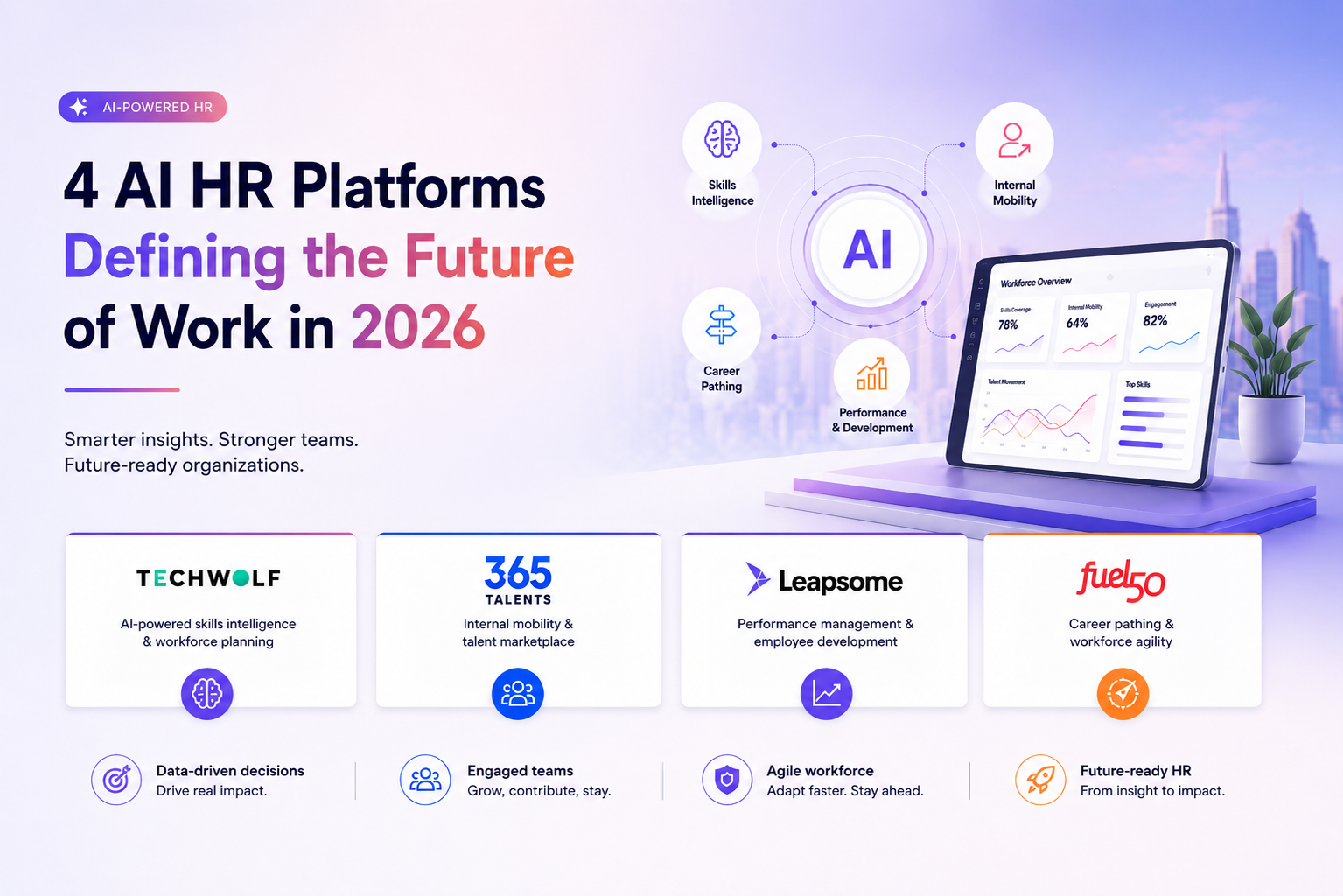
TechWolf: Turning Workforce Data into Skills Intelligence
One of the biggest shifts in human resource management is the move from job-based planning to skills-based planning. Companies can no longer rely on job titles to understand workforce capabilities because employees continuously develop new competencies through projects, certifications, and day-to-day work.
TechWolf has emerged as one of the most innovative platforms supporting this transition. Instead of asking employees to manually update skill profiles, the platform uses AI to analyze enterprise data from collaboration tools, learning systems, project platforms, and HR software to build dynamic skill profiles automatically.
This approach gives HR leaders a real-time view of organizational capabilities rather than outdated employee records. As businesses invest heavily in AI transformation initiatives, understanding which skills already exist internally has become far more valuable than continuously hiring external talent.
The platform also supports workforce planning by helping organizations identify future skill gaps before they become business risks. In 2026, when companies are under pressure to balance hiring costs with internal mobility, this capability has become increasingly valuable.
365Talents: Reinventing Internal Mobility
Hiring externally has become both expensive and unpredictable. As a result, organizations are focusing more on unlocking opportunities for employees who are already part of the company.
365Talents is helping redefine internal talent marketplaces by using AI to connect employees with projects, mentorship programs, stretch assignments, learning opportunities, and new career paths based on their skills and aspirations rather than their current roles.
This reflects one of the strongest workforce trends of 2026: organizations are treating employees as dynamic talent pools instead of fixed positions within organizational charts.
The platform’s recommendation engine identifies opportunities employees might never have discovered on their own, increasing engagement while reducing voluntary turnover. At the same time, HR teams gain greater visibility into internal talent availability before initiating external recruitment.
For enterprises facing talent shortages in critical functions, improving internal mobility has become a strategic advantage rather than simply an employee engagement initiative.
Leapsome: Bringing Performance, Learning, and AI Together
Performance management has undergone significant change over the past few years. Annual performance reviews have gradually been replaced by continuous feedback, coaching, learning, and goal alignment.
Leapsome reflects this evolution by combining OKRs, employee engagement surveys, performance reviews, learning management, competency frameworks, and AI-powered coaching into a single platform.
Rather than treating performance management as an isolated HR process, Leapsome creates a continuous employee development ecosystem where managers receive intelligent recommendations, employees receive personalized growth guidance, and leadership gains visibility into organizational performance trends.
One of the reasons the platform is attracting attention in 2026 is its ability to integrate AI without replacing human leadership. AI assists managers by suggesting feedback, identifying engagement risks, and recommending learning content, allowing leaders to spend more time coaching rather than managing administrative tasks.
As organizations continue adopting AI assistants across departments, HR leaders are increasingly looking for platforms that augment decision-making instead of automating it entirely.
Fuel50: Preparing Employees for Tomorrow’s Roles
Few HR challenges are more difficult than preparing employees for jobs that don’t yet exist.
The rapid evolution of AI has accelerated changes in workforce requirements, making career planning far more dynamic than it was only a few years ago.
Fuel50 focuses on career pathing, workforce agility, and skills intelligence by helping employees visualize future career opportunities inside their organizations while recommending learning paths that align with emerging business needs.
Instead of waiting until skill shortages become critical, organizations can proactively guide employees toward high-demand roles using AI-generated career recommendations and personalized development journeys.
For enterprise leaders investing in long-term workforce resilience, this approach supports succession planning, talent retention, and organizational agility simultaneously.
As businesses increasingly adopt skills-based operating models, career pathing is becoming less about promotions and more about continuous capability development across evolving business priorities.
Why These Platforms Matter More Than Ever
The conversation around AI in HR is shifting away from automation alone. The next generation of workforce technology is focused on helping organizations understand people more effectively, develop talent continuously, and make workforce decisions using real-time intelligence instead of historical assumptions.
What’s particularly interesting is that each of these platforms addresses a different part of the employee lifecycle, yet they all contribute toward the same objective: building an adaptable workforce capable of responding to constant technological change.
For B2B decision-makers, this represents an important strategic shift. Investing in AI-powered HR technology is no longer simply about improving operational efficiency or reducing administrative work. It is increasingly about creating organizational resilience in a business environment where skills become outdated faster than ever before.
As AI reshapes industries, competitive advantage will belong to companies that can identify emerging skills, develop existing talent, and redeploy employees faster than competitors. Platforms like TechWolf, 365Talents, Leapsome, and Fuel50 may not generate as much industry buzz as larger enterprise suites, but they are quietly influencing how forward-thinking organizations prepare for the future of work.
In 2026, the most successful HR teams won’t necessarily be those with the biggest technology budgets. They’ll be the ones using AI to build smarter, more agile, and more human-centered workforces—where skills, growth, and adaptability become the foundation of long-term business success.