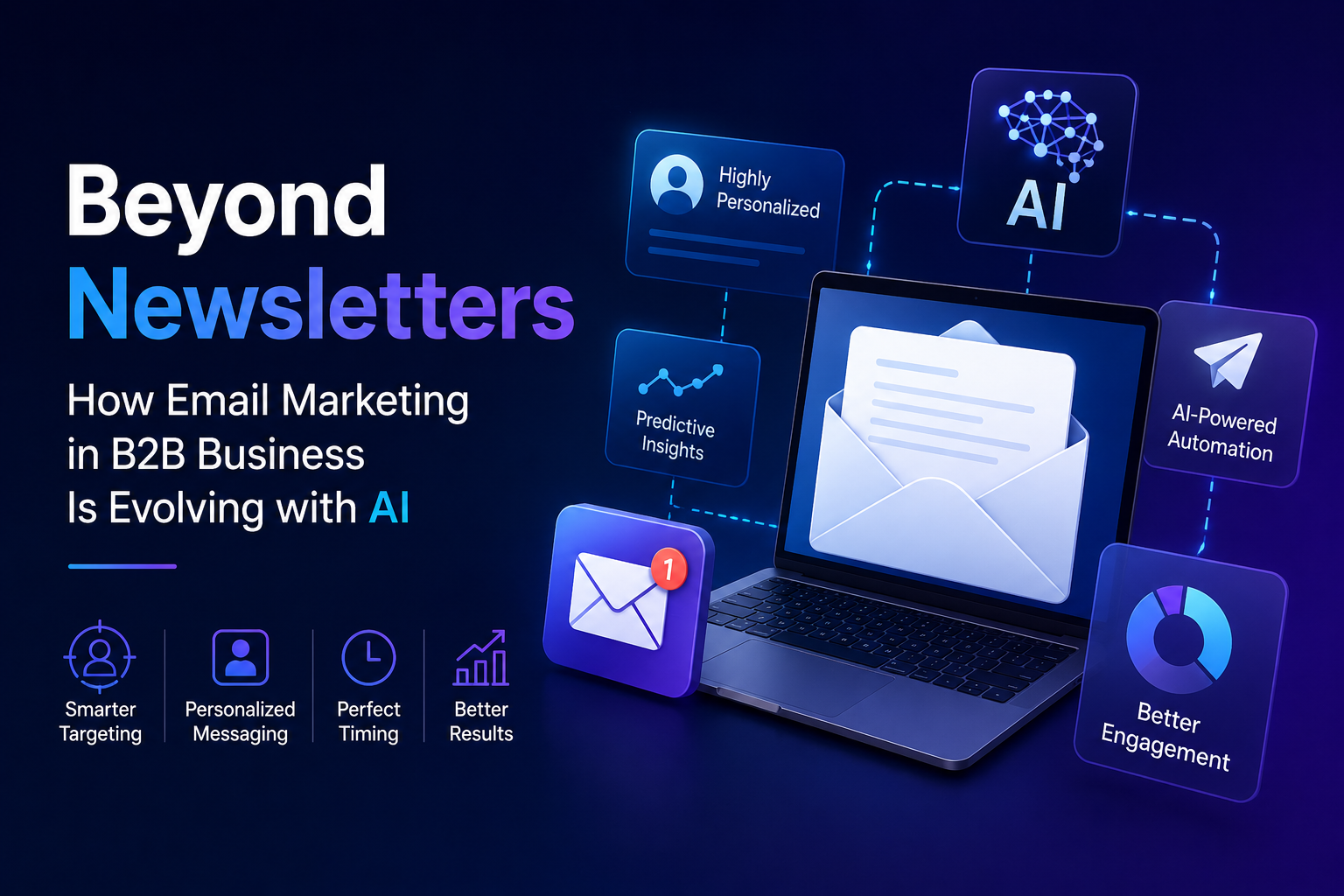
AI has changed almost every marketing channel—but email remains one of the highest-performing investments for B2B businesses.
The difference today isn’t whether companies use email. It’s how they use it.
Buyers expect personalized conversations, relevant recommendations, and perfectly timed follow-ups—not generic newsletters sent to thousands of inboxes.
That’s why AI is rapidly transforming email marketing in B2B business helping marketers create smarter campaigns without increasing manual effort.
Why AI Is Becoming Essential for B2B Email Marketing
Unlike B2C marketing, B2B buying decisions often involve multiple stakeholders, longer sales cycles, and several touchpoints before a purchase is made.
A single prospect might download a whitepaper, attend a webinar, compare competitors, and request a product demo before speaking with a sales representative.
Managing this journey manually is difficult.
AI allows marketers to analyze customer behavior, identify buying signals, personalize messaging, and determine the best time to engage each prospect. Instead of sending identical emails to thousands of contacts, businesses can create campaigns that feel tailored to individual recipients.
The result isn’t simply more emails—it’s better conversations.
Four Underrated AI Tools That Deserve More Attention
While platforms like ChatGPT have become household names, several emerging AI tools are quietly helping B2B marketers improve their email performance.
- Lavender
Writing sales emails that people actually respond to is challenging. Lavender acts as an AI-powered email coach that analyzes your message as you write, suggesting improvements for readability, tone, personalization, and clarity.
It also evaluates how likely your email is to receive a response, making it particularly useful for outbound sales teams and founders reaching decision-makers for the first time.
Instead of rewriting your emails completely, Lavender focuses on helping you write messages that sound more human and less like mass marketing.
- Warmer.ai
Personalization has become one of the biggest success factors in B2B outreach, but researching every prospect manually isn’t scalable.
Warmer.ai generates highly personalized email introductions by analyzing publicly available information about your prospects, including their company, professional background, and recent activity.
This helps businesses create outreach emails that immediately establish relevance without spending hours researching every lead.
For companies focused on account-based marketing (ABM), this can significantly improve engagement rates.
- Hoppy Copy
Most AI writing tools generate content for blogs or advertisements, but Hoppy Copy focuses specifically on email marketing.
It helps marketers create nurture sequences, promotional campaigns, welcome emails, product announcements, and newsletter content while maintaining a consistent brand voice.
Its AI templates are designed around email performance rather than general content creation, making it a valuable option for businesses that send campaigns regularly.
- Customer.io AI
Customer.io has long been known for behavioral email automation, but its AI capabilities are becoming increasingly valuable for B2B marketers.
Instead of relying solely on static workflows, businesses can trigger emails based on user behavior, product activity, engagement history, or purchasing intent.
For SaaS companies and technology businesses, this creates highly relevant communication throughout the customer lifecycle—from onboarding to retention.
AI Doesn’t Replace Strategy
One of the biggest misconceptions about AI is that it can create successful email campaigns automatically.
In reality, AI excels at execution, while strategy remains a human responsibility.
Businesses still need to understand their audience, define their messaging, and build trust over time. AI simply accelerates the process by helping marketers write faster, personalize communication more effectively, and identify opportunities they might otherwise overlook.
The strongest campaigns are still built around valuable insights rather than automation alone.
Best Practices for Modern Email Marketing in B2B Business
Successful email marketing isn’t about sending more emails—it’s about sending the right message at the right moment.
That starts with meaningful audience segmentation. Instead of grouping prospects solely by industry, consider their stage in the buying journey, previous interactions, and business challenges.
Personalization should extend beyond simply adding a recipient’s first name. Referencing relevant pain points, industry trends, or company goals creates emails that feel genuinely helpful.
Testing also remains essential. Subject lines, email length, call-to-action placement, and sending times all influence performance. AI can help analyze these patterns, but consistent experimentation is what drives long-term improvement.
Finally, focus on providing value before asking for a sale. Educational content, industry insights, case studies, and practical resources tend to build stronger relationships than purely promotional messaging.
The Future of B2B Email Marketing
Email marketing continues to evolve alongside artificial intelligence.
Rather than replacing marketers, AI is becoming an intelligent assistant that supports research, personalization, content creation, and campaign optimization.
Businesses that embrace these capabilities are better positioned to engage prospects with relevant, timely, and meaningful communication.
As inboxes become more competitive, success will depend less on sending higher volumes of emails and more on delivering messages that genuinely resonate with the people receiving them.
For organizations looking to strengthen email marketing in B2B business,The future of email marketing in B2B business isn’t about sending more emails—it’s about sending better ones.
AI enables marketers to personalize every interaction, automate repetitive tasks, and identify opportunities that would otherwise go unnoticed.
Businesses that combine intelligent automation with genuine human insight will build stronger relationships, higher engagement, and better long-term results.
As AI continues to evolve, the companies that embrace it thoughtfully won’t just keep up—they’ll set the standard for modern B2B communication.