Project management software used to have a fairly simple job: organize tasks, assign owners, track deadlines, and keep everyone looking at the same board. That model made sense when work moved through predictable processes and project updates happened in scheduled meetings. In 2026, however, the nature of work looks very different. Teams are distributed, projects move across departments, decisions happen inside conversations, and AI is beginning to move from answering questions to actually completing workflow tasks.
The latest shift toward agentic AI and AI-assisted operations is changing what businesses should expect from project management technology. Recent research is already exploring project-specific and role-based AI agents, while enterprise adoption of digital assistants is accelerating across operational workflows. The emerging expectation is clear: software should reduce coordination work, surface context, and help teams act—not simply store tasks.
For B2B decision makers reviewing their project management stack, the obvious names are no longer the only options worth considering. A new group of quieter platforms is approaching modern work from very different angles.
Plane
Plane feels like a project management platform designed after someone asked a simple question: what if AI actually understood the project instead of sitting in a separate chatbot window?
The platform combines project management, documentation, and AI-powered workflows within a unified workspace. Its AI can work with project context, summarize progress, identify blockers, help triage incoming work, and support agents assigned to work items. Plane also offers natural-language search and increasingly deep workflow automation. Its 2026 updates have continued expanding AI, dashboards, permissions, MCP capabilities, and project intelligence.
For business leaders, Plane’s appeal is less about another attractive task board and more about operational visibility. Teams can manage initiatives, projects, cycles, documentation, and workflows without constantly rebuilding context across different tools. Its self-hosted and air-gapped deployment options also make it interesting for enterprises where data control and governance are part of the software buying conversation.
Plane represents a broader trend in project management: the platform is slowly becoming an execution layer for both people and AI agents.
Fibery
Most project management platforms ask companies to adapt their processes to the software. Fibery takes almost the opposite approach.
Fibery is built around connected work. Product development, customer feedback, research, strategy, objectives, and execution can exist as related information rather than isolated databases. This makes the platform particularly interesting for organizations where projects rarely follow a clean, linear path.
The bigger business problem Fibery addresses is context fragmentation. A customer insight may influence a product decision. That decision may create an initiative. The initiative may generate multiple projects. Traditional project management systems often capture the final tasks but lose the relationships that explain why those tasks exist.
Fibery’s connected workspace model makes those relationships more visible. Its recent product direction also reflects the growing role of AI, automations, and integrations in operational workflows.
For B2B teams managing complex products, innovation programs, or cross-functional initiatives, that connected structure can be valuable. Leadership does not simply see whether a task is complete. Teams can build a clearer picture of how research, decisions, strategy, and execution connect.
In an era where companies generate more operational data than ever, Fibery’s strength may be its ability to turn relationships between information into something teams can actually navigate.
Superthread
Meetings create an enormous amount of project information. The problem is that much of it disappears the moment the call ends.
Decisions stay in transcripts. Action items remain buried in notes. Someone promises to create a task later. A week passes, and the team spends another meeting trying to remember what was agreed.
Superthread is designed around closing that gap. It brings tasks, documentation, calendars, timelines, and AI-assisted meeting workflows into one environment. Its AI capabilities can transcribe meetings, generate summaries, extract next steps, and create tasks or updates from project conversations.
That approach feels increasingly relevant as businesses reconsider where project management actually begins. Work does not always start with someone opening a task board. It often starts in a conversation, a customer meeting, a Slack discussion, or a planning session.
For decision makers, Superthread raises an important question: how much project information is currently being lost between communication and execution?
The next generation of project management tools may be judged by how quickly they turn conversations into structured action. Superthread is already building around that idea.
Leantime
Project management software has spent years adding more features. Leantime is interesting because it focuses heavily on making work easier to understand.
Designed with cognitive accessibility and neurodivergent users in mind, Leantime connects goals, strategy, milestones, and everyday tasks. Instead of treating project management as pure administration, the platform tries to give teams a clearer sense of why work matters and how individual tasks contribute to larger outcomes.
Its AI capabilities support task prioritization, task breakdown, status updates, and status reporting. Leantime also combines personal work views, time blocking, strategic goals, project blueprints, retrospectives, and knowledge management.
This matters because the productivity challenge inside many businesses is not a lack of task data. It is cognitive overload. Employees are surrounded by dashboards, notifications, requests, meetings, and shifting priorities. Adding another complex project platform can sometimes make the problem worse.
Leantime’s approach suggests a different future for project management technology: software that helps people understand and prioritize work rather than simply recording more of it.
The Best Project Management Tool May Be the One You Haven’t Considered Yet
The project management market is moving beyond digital task boards. AI agents, connected knowledge, automated project administration, and context-aware workflows are becoming more central to how modern platforms are designed. Recent research on agentic project management even frames future AI systems as collaborative “junior project manager” style systems operating with different levels of human oversight.
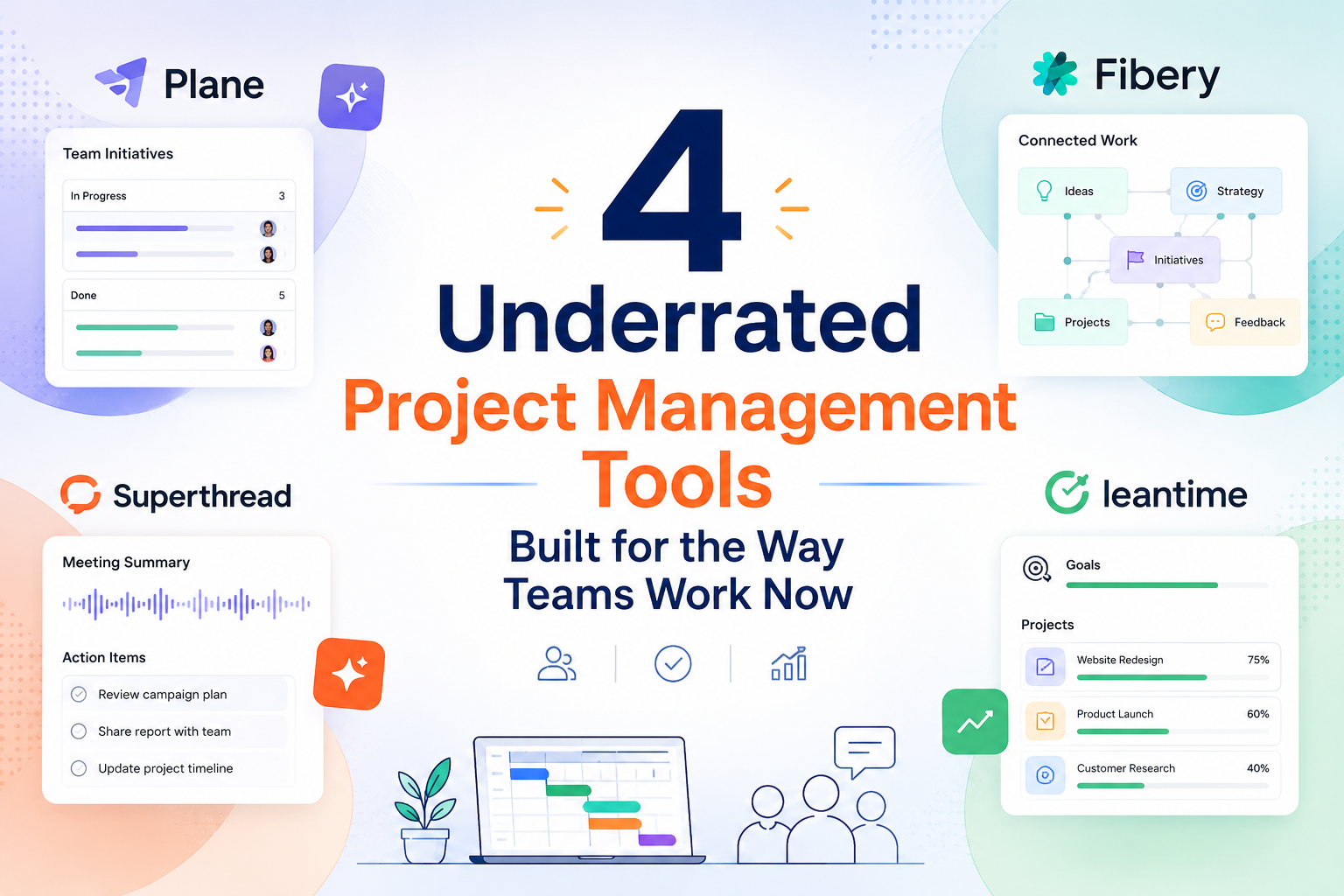
Plane, Fibery, Superthread, and Leantime are not identical alternatives to the largest project management platforms. That is precisely what makes them interesting. Each is questioning a different assumption about how teams should organize work.
For B2B decision makers, the smarter software conversation in 2026 may not be about which platform has the longest feature list. It may be about identifying where work currently loses context, momentum, or clarity and choosing technology built specifically to solve that problem.