
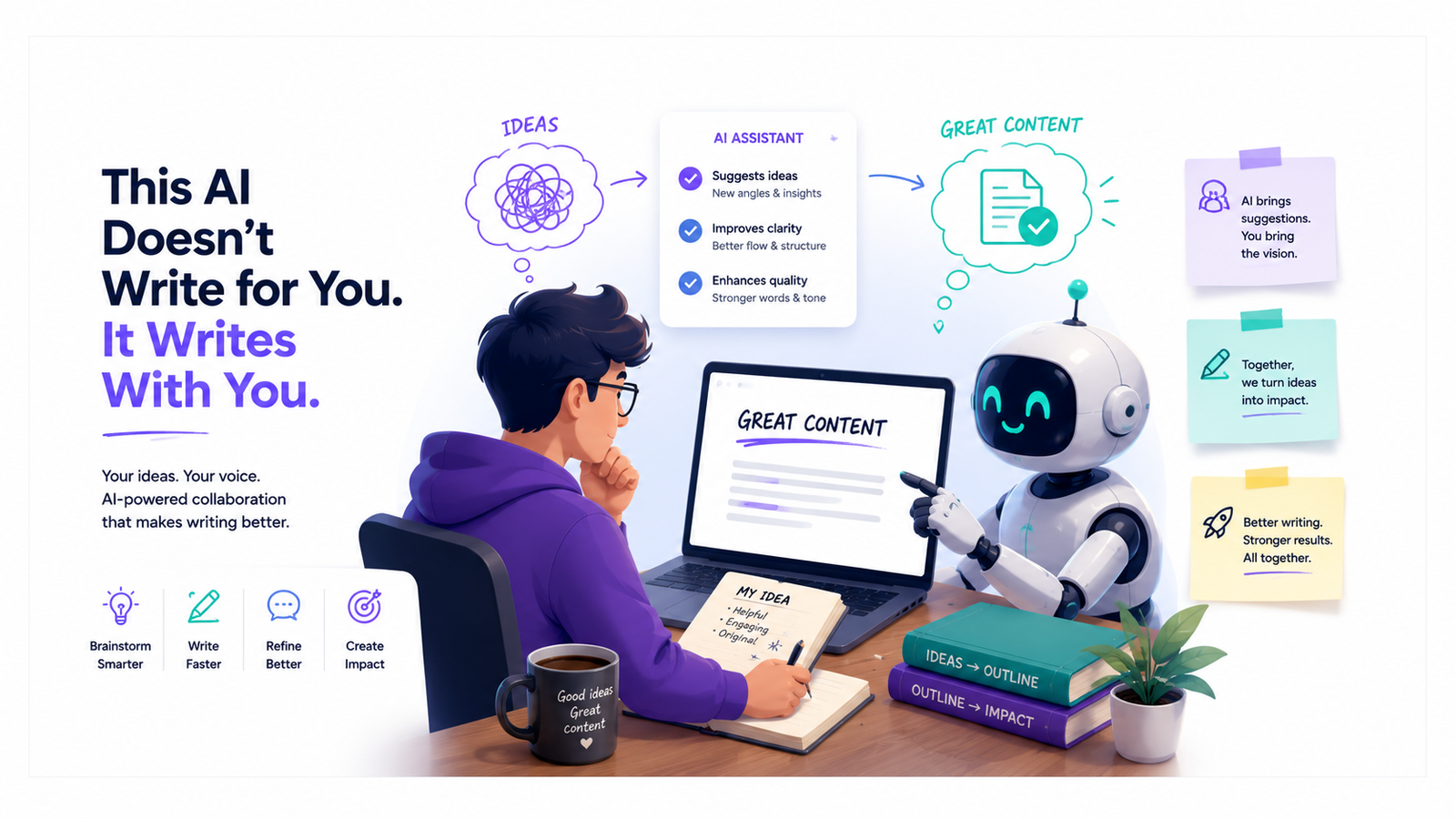
The best AI writing tools aren’t replacing human creativity, they’re making it sharper, faster, and more intentional.
Every few months, a new headline claims that artificial intelligence is about to replace writers. Social media debates erupt, professionals worry about job security, and another AI writing tool enters the market promising to generate articles, emails, or marketing copy in seconds.
Yet something interesting is happening among people who write every day.
Content marketers, researchers, journalists, founders, and students aren’t handing over their work to AI and walking away. They’re doing something far more practical. They’re treating AI as a collaborator rather than a replacement.
The most effective AI writing tools today don’t take over the creative process. They strengthen it.
The Biggest Misunderstanding About AI Writing
There’s a common assumption that AI writing assistants exist to produce finished content with a single prompt. While that’s technically possible, it rarely leads to exceptional work.
The strongest writing still depends on human judgment. Choosing the right angle, understanding an audience, building an argument, and telling a compelling story are creative decisions that AI can’t fully own.
Where AI excels is everywhere in between.
It helps organize scattered thoughts, suggest alternative wording, simplify technical explanations, improve readability, identify inconsistencies, and overcome one of the biggest productivity killers for writers: the blank page.
Think of AI less as an author and more as an experienced editor sitting beside you.
From Draft Generator to Creative Partner
Modern AI writing tools have evolved beyond basic text generation.
Many now understand tone, structure, formatting, audience intent, and even the purpose behind different types of content. Instead of simply completing sentences, they participate in the writing process.
A writer can ask AI to brainstorm headlines, refine introductions, shorten paragraphs, explain technical jargon in simpler language, or rewrite content for different audiences without starting over.
This collaborative workflow allows writers to focus on ideas instead of repetitive editing.
The New Writing Workflow
Professional creators are increasingly following a pattern that blends human creativity with AI efficiency.
They begin with their own ideas, experience, and expertise. AI then helps organize those ideas into a logical structure, suggests stronger transitions, improves clarity, and catches inconsistencies.
The writer reviews every suggestion, adds personal insight, adjusts the tone, and ensures the final piece reflects their unique voice.
Rather than replacing creativity, AI removes the repetitive work surrounding it.
Different Tools, Different Strengths
Not every AI writing assistant solves the same problem.
Some tools specialize in long-form content planning and brainstorming. Others focus on grammar and clarity. Several are designed for collaborative note-taking, research, or documentation, while newer platforms integrate directly into browsers, email clients, and document editors.
Choosing the right tool depends less on which model is “smartest” and more on where it fits into your workflow.
The best writers often combine multiple tools instead of relying on just one.
Why Human Voice Still Matters
One challenge has become increasingly clear as AI-generated content floods the internet.
Readers can often recognize generic writing.
Content that lacks original thinking, real-world experience, or meaningful perspective quickly blends into thousands of similar articles.
Search engines are also placing greater emphasis on helpful, trustworthy, people-first content. Original insights, firsthand experience, and genuine expertise remain difficult for AI to invent convincingly.
That’s why the human role is becoming more valuable, not less.
AI can improve language, but it cannot replace lived experience, industry knowledge, or authentic storytelling.
Where AI Makes the Biggest Difference
The greatest productivity gains often come from smaller tasks that writers repeat every day.
AI can summarize lengthy reports, convert meeting notes into articles, generate social media variations, rewrite paragraphs for different audiences, create outlines, improve headlines, and suggest stronger calls to action.
Instead of spending hours on formatting or rewriting, writers can invest that time in research, interviews, and developing stronger ideas.
The result isn’t necessarily more content.
It’s better content produced more efficiently.
Collaboration Is the Future
The conversation around AI writing is gradually shifting.
Early discussions focused on automation and replacement. Today’s conversations revolve around collaboration.
Professionals are discovering that AI performs best when guided by clear goals, thoughtful prompts, and human oversight.
The technology isn’t replacing the writer sitting at the keyboard.
It’s becoming another creative tool alongside search engines, design software, grammar checkers, and note-taking apps.
The Skills That Matter Most
As AI becomes part of everyday writing, the most valuable skills are also changing.
Knowing how to ask better questions, evaluate AI-generated suggestions, verify information, edit for clarity, and maintain a consistent brand voice will increasingly separate great writers from average ones.
In many ways, writing is becoming less about typing faster and more about thinking better.
AI accelerates execution.
Humans provide direction.
Final Thoughts
The most successful writers in the coming years won’t be those who reject AI or those who depend on it entirely.
They’ll be the people who understand how to collaborate with it.
The best AI writing assistants don’t replace creativity. They remove friction, organize ideas, sharpen communication, and free writers to focus on what machines still struggle to replicate: curiosity, empathy, critical thinking, and original perspective.
That’s why the future of writing isn’t human versus AI.
It’s human with AI and that partnership is already changing how great content gets created.