
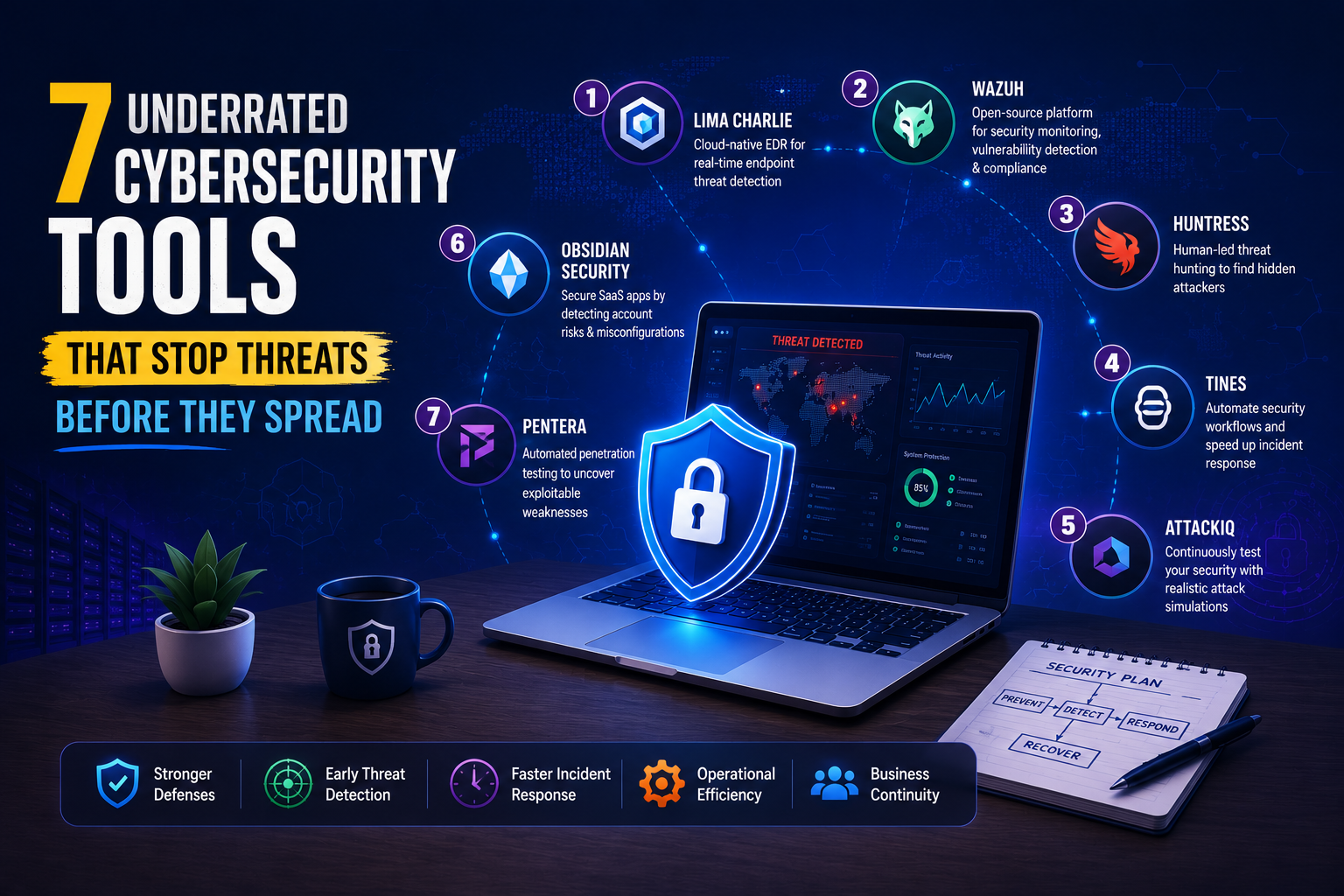


7 Underrated Cybersecurity Tools That Stop Threats Before They Spread

Cyberattacks are becoming faster, smarter, and more difficult to detect. While organizations continue investing in well-known antivirus software and firewalls, many of the most effective security solutions remain surprisingly overlooked. These underrated cybersecurity tools aren’t necessarily the biggest names in the industry, but they’re helping businesses detect suspicious behavior, identify vulnerabilities, and contain attacks before they escalate into costly breaches. As ransomware, phishing campaigns, and insider threats continue to evolve, modern security teams are expanding their technology stacks with specialized platforms designed to stop threats long before they make headlines.
1. LimaCharlie
LimaCharlie is a cloud-native endpoint detection and response (EDR) platform that gives security teams deep visibility across Windows, macOS, and Linux devices.
Unlike traditional antivirus software, it continuously monitors endpoint activity and helps detect suspicious behavior in real time. Its automation capabilities allow analysts to isolate compromised devices, investigate incidents, and respond quickly without disrupting entire networks.
For organizations building flexible security operations, LimaCharlie provides enterprise-grade capabilities without the complexity of larger security platforms.
2. Wazuh
Wazuh has quietly become one of the most respected open-source security platforms available today.
It combines endpoint detection, security monitoring, log analysis, vulnerability detection, compliance reporting, and file integrity monitoring into a single solution. Security teams appreciate its ability to centralize threat visibility while reducing the cost of enterprise monitoring.
Its open-source model also allows organizations to customize deployments according to their own security requirements.
3. Huntress
Many cyberattacks remain hidden long after initial compromise. Huntress specializes in identifying persistent threats that traditional security tools often overlook.
The platform continuously monitors endpoints for unusual activity and combines automated detection with human-led threat hunting. This hybrid approach helps organizations uncover hidden attackers before significant damage occurs.
Small and mid-sized businesses increasingly rely on Huntress to strengthen security without building large internal security teams.
4. Tines
Security analysts often spend valuable time repeating manual tasks instead of investigating active threats. Tines helps eliminate this problem through intelligent security automation.
The platform connects multiple security products and automates repetitive workflows such as phishing investigations, incident response, ticket creation, and user notifications.
By reducing manual effort, security teams can respond faster while improving operational efficiency.
5. AttackIQ
AttackIQ allows organizations to continuously test their cybersecurity defenses using simulated attack scenarios.
Instead of waiting for real attackers to expose weaknesses, businesses can proactively identify security gaps across endpoints, cloud infrastructure, and networks. Regular validation ensures security controls continue performing as expected even as threats evolve.
Continuous security testing has become an increasingly important part of mature cybersecurity strategies.
6. Obsidian Security
As organizations adopt more SaaS applications, securing cloud-based collaboration platforms has become increasingly challenging.
Obsidian Security focuses specifically on protecting SaaS environments by monitoring user behavior, detecting compromised accounts, and identifying risky configurations before attackers can exploit them.
Its visibility across cloud applications helps organizations strengthen security beyond traditional network boundaries.
7. Pentera
Penetration testing has traditionally been time-consuming and expensive. Pentera automates many aspects of internal security validation by safely simulating real-world cyberattacks.
Organizations receive immediate insights into exploitable weaknesses, privilege escalation paths, and potential business risks without waiting for scheduled penetration tests.
This continuous validation helps security teams prioritize remediation efforts based on actual attack scenarios instead of theoretical vulnerabilities.
Why Specialized Security Tools Matter
Modern cyber threats rarely rely on a single attack method. Attackers combine phishing, credential theft, ransomware, cloud exploitation, and lateral movement to bypass traditional defenses.
That’s why security leaders are increasingly investing in layered security strategies that combine endpoint protection, automation, threat detection, cloud monitoring, and continuous validation.
Specialized tools fill security gaps that traditional antivirus software alone cannot address.
Looking Ahead
Cybersecurity is evolving from reactive protection toward continuous threat detection and proactive defense. Organizations that embrace specialized security platforms gain greater visibility into emerging risks while responding faster to incidents before they spread throughout the business.
While these tools may not dominate industry headlines, they are quietly becoming essential components of modern security operations. Businesses that evaluate and adopt innovative cybersecurity technologies today will be better prepared for tomorrow’s increasingly sophisticated threat landscape.
For professionals looking to stay informed about emerging cybersecurity technologies, software innovation, and enterprise IT trends, Tools Metric continues to highlight practical solutions that help businesses strengthen their technology stack before threats become tomorrow’s headlines.


