





The AI Tools Everyone Will Be Talking About Next Year (But Almost Nobody Uses Today)

Every few months, a new AI tool dominates social media. One week it’s ChatGPT, the next it’s Claude, Midjourney, or Perplexity. While these platforms deserve the attention they’ve earned, they also create an interesting problem—thousands of genuinely useful AI tools never get the spotlight.

Some of the most innovative platforms aren’t trying to become household names. Instead, they’re quietly solving specific business challenges, helping teams automate repetitive work, create better content, analyze data faster, and collaborate more efficiently. The companies using these hidden gems often gain a productivity advantage long before everyone else catches on.

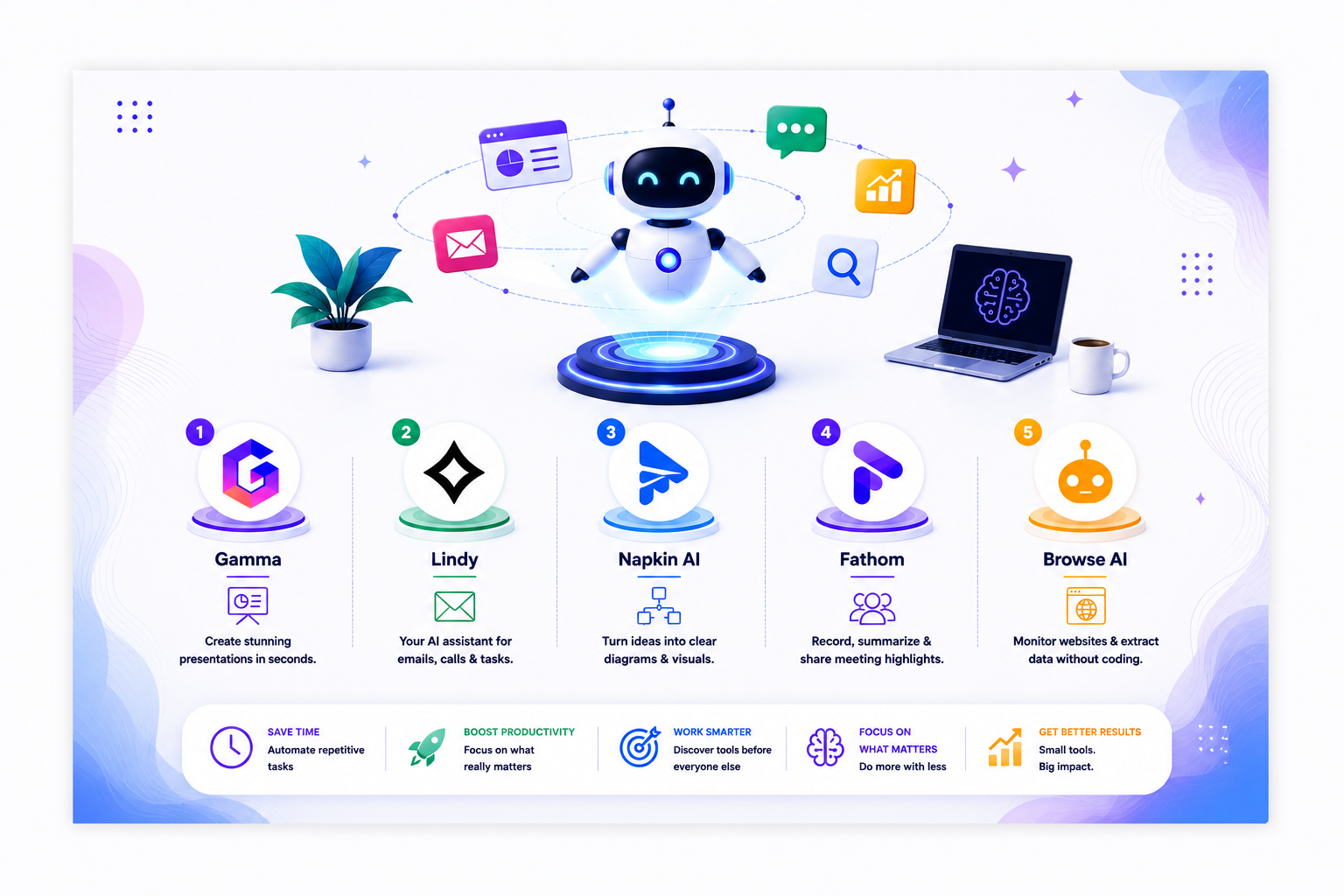
If you’re looking beyond the usual AI recommendations, here are five underrated tools that deserve far more attention than they currently receive.

1. Gamma – Presentations Without the Presentation Work

Creating professional presentations often takes longer than the actual meeting. Designing slides, arranging layouts, and making everything visually appealing can easily consume hours.

Gamma changes that completely.

Instead of starting with a blank slide deck, users simply describe their topic. The platform automatically generates a polished presentation complete with layouts, visuals, and structured content. Unlike traditional presentation software, Gamma feels more like working with an intelligent design assistant.

Its collaborative editing, responsive layouts, and interactive elements also make presentations easier to share across teams.

For startups, consultants, marketers, and business leaders, Gamma dramatically reduces the time between an idea and a client-ready presentation.

2. Lindy – Your AI Executive Assistant

Businesses spend an enormous amount of time coordinating calendars, following up on emails, scheduling meetings, and handling repetitive administrative work.

Lindy automates many of these everyday responsibilities.

It can schedule meetings, respond to emails, prepare summaries, connect with business applications, and trigger workflows without requiring constant manual input. Instead of acting like a simple chatbot, Lindy behaves more like a digital executive assistant capable of managing recurring operational tasks.

As organizations continue exploring AI agents, Lindy represents an early example of how AI can actively participate in business operations rather than simply answering questions.

3. Napkin AI – Turning Ideas into Visual Stories

Communicating complex ideas often requires diagrams, process maps, or visual explanations. Unfortunately, creating those graphics usually demands both design skills and additional software.

Napkin AI removes that barrier.

Users simply write text describing an idea, and the platform automatically transforms it into professional-looking diagrams, flowcharts, infographics, and structured visuals. Whether you’re preparing a business proposal, explaining a workflow, or creating educational content, the tool makes visual communication significantly faster.

For professionals who frequently explain concepts to clients or stakeholders, Napkin AI can replace hours of manual design work with just a few clicks.

4. Fathom – The Meeting Tool That Lets You Stop Taking Notes

Meetings generate valuable information, yet much of it disappears because participants are busy taking notes instead of actively listening.

Fathom solves this problem by automatically recording, transcribing, summarizing, and highlighting important moments from virtual meetings.

Rather than reviewing an hour-long recording, users receive concise summaries, action items, and searchable transcripts that can be shared across teams. It also integrates with CRM platforms, allowing meeting insights to flow directly into sales and customer management workflows.

For remote teams and customer-facing organizations, Fathom turns meetings into searchable knowledge rather than forgotten conversations.

5. Browse AI – Web Monitoring Without Writing Code

Businesses constantly monitor competitor pricing, product launches, market changes, and public data across countless websites. Traditionally, collecting this information required developers or complex scraping software.

Browse AI makes web automation accessible to everyone.

Without writing code, users can train AI to extract information from websites, monitor changes, and automate repetitive data collection tasks. Whether tracking competitor updates, monitoring inventory, or gathering research data, Browse AI transforms manual monitoring into an automated workflow.

For marketers, researchers, sales teams, and analysts, it offers enterprise-level automation without technical complexity.

Why Specialized AI Tools Are Gaining Momentum

One of the biggest trends shaping AI software isn’t simply building larger language models—it’s creating tools designed to solve very specific business problems.

Rather than becoming another all-purpose chatbot, these platforms focus on improving one workflow exceptionally well. Presentation design, meeting intelligence, administrative automation, visual communication, and web monitoring may seem like niche use cases individually, but together they eliminate countless hours of repetitive work.

Businesses are increasingly discovering that combining specialized AI applications with their existing workflows often delivers greater productivity than relying on a single platform for everything.

This shift is creating a new generation of AI software where practical business value matters more than widespread popularity.

Final Thoughts

The next wave of AI innovation isn’t hiding inside the tools everyone already knows.

It’s emerging through specialized platforms that quietly solve everyday business problems with remarkable efficiency. While larger AI platforms continue evolving, these underrated applications demonstrate that meaningful innovation often happens in focused, practical ways.

Organizations willing to experiment with lesser-known tools today may discover significant competitive advantages before the rest of the market catches up.

Sometimes the smartest technology isn’t the one making headlines—it’s the one saving your team hours every single day.

Whether you’re looking to streamline meetings, automate research, create better presentations, or simplify business operations, these five underrated AI tools prove that the future of productivity is already here. The only question is whether you’ll discover them before everyone else does.

Vansh Banthia
We will be happy to hear your thoughts

Leave a reply

ToolsMetric
Logo
Compare items
  • Total (0)
Compare
0