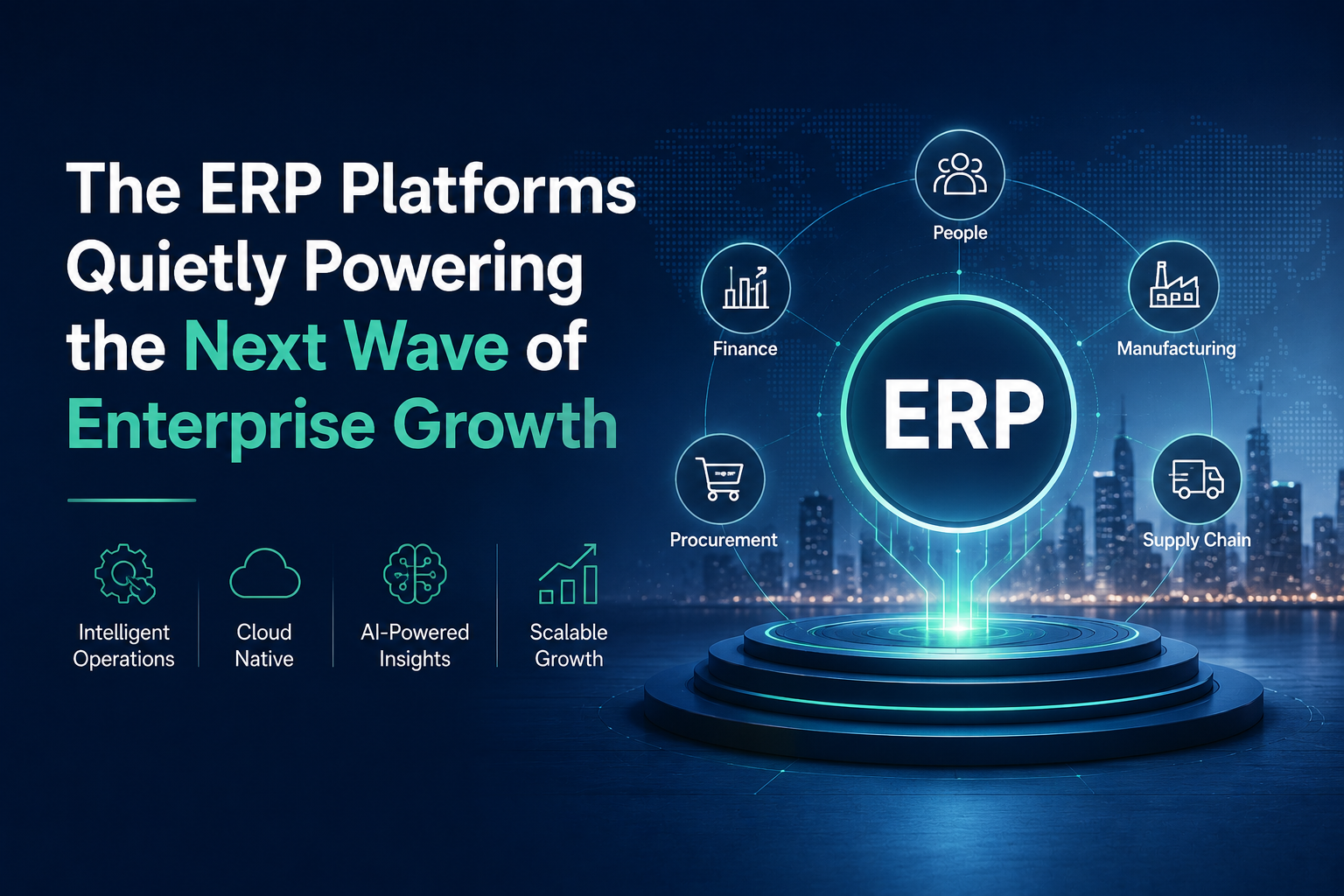
Enterprise Resource Planning has entered a new era. For decades, ERP systems were viewed primarily as back-office platforms designed to manage finance, inventory, procurement, and operations. Today, they are evolving into intelligent business platforms that connect data, automate decision-making, and support AI-driven enterprise operations.
This transformation is being accelerated by several major trends shaping the technology landscape in 2026. Artificial intelligence is becoming deeply embedded within enterprise software, cloud-native architectures are replacing on-premise deployments, and organizations are prioritizing operational resilience alongside efficiency. Rather than simply digitizing processes, businesses are looking for ERP platforms that can generate predictive insights, automate workflows, and provide real-time visibility across every department.
While SAP, Oracle, and Microsoft Dynamics continue to dominate enterprise conversations, several modern ERP platforms are quietly gaining momentum by solving industry-specific challenges with greater flexibility and innovation. For B2B decision-makers evaluating the future of enterprise technology, these platforms deserve closer attention.
IFS Cloud
Among modern ERP platforms, IFS Cloud has established itself as one of the strongest solutions for asset-intensive industries including manufacturing, aerospace, energy, construction, and utilities. Instead of focusing solely on financial management, IFS brings together enterprise resource planning, enterprise asset management, and field service management within a unified cloud platform.
Its growing investment in artificial intelligence has made predictive maintenance and operational intelligence central capabilities rather than optional features. Organizations can identify equipment issues before failures occur, optimize maintenance schedules, and improve workforce productivity using AI-generated recommendations.
As enterprises continue investing in industrial AI and connected operations, platforms like IFS Cloud demonstrate how ERP is evolving from a record-keeping system into an operational intelligence platform that directly influences business performance.
Unit4 ERPx
Not every enterprise revolves around manufacturing or supply chains. Consulting firms, higher education institutions, professional services organizations, and public sector agencies require ERP systems that prioritize people rather than physical assets.
Unit4 ERPx addresses this need by placing finance, project management, HR, and workforce planning at the center of enterprise operations. Its cloud-native architecture simplifies complex service-based workflows while embedded AI helps automate administrative processes, financial forecasting, and resource planning.
Recent developments across enterprise software have highlighted the growing importance of employee productivity and operational agility. Organizations increasingly need systems capable of adapting to changing workforce structures without requiring large-scale infrastructure changes. Unit4 ERPx aligns closely with this direction by helping organizations improve operational efficiency while keeping people at the center of decision-making.
Acumatica Cloud ERP
Cloud-native ERP adoption continues accelerating as organizations seek greater flexibility and faster innovation cycles. Acumatica Cloud ERP has emerged as one of the strongest alternatives for manufacturers, distributors, retailers, and construction companies that want enterprise capabilities without the complexity often associated with legacy platforms.
Its open architecture enables businesses to integrate CRM platforms, analytics tools, eCommerce systems, and third-party applications with relative ease. This flexibility has become increasingly valuable as organizations modernize technology stacks built around APIs rather than isolated enterprise software.
Artificial intelligence also plays a growing role within Acumatica through intelligent automation, financial insights, inventory optimization, and workflow improvements. Instead of requiring organizations to replace existing systems entirely, the platform allows businesses to modernize operations gradually while preserving existing investments.
For enterprises pursuing digital transformation, this balance between flexibility and enterprise capability makes Acumatica an increasingly attractive option.
Rootstock ERP
Manufacturing organizations continue facing growing pressure to improve supply chain resilience while responding faster to changing customer demand. Rootstock ERP addresses this challenge through its cloud-native platform built directly on Salesforce, creating a tightly connected ecosystem between sales, production, inventory, procurement, and customer service.
Because customer relationship management and enterprise resource planning share the same underlying platform, organizations gain real-time visibility from initial customer engagement through manufacturing, fulfillment, and post-sale support. This connected approach reduces operational silos while improving forecasting accuracy and production planning.
Rootstock has also expanded its AI capabilities by introducing intelligent analytics, demand forecasting, and supply chain optimization that help manufacturers make faster operational decisions. As enterprises continue investing in unified customer and operational data, platforms built around connected intelligence are becoming increasingly valuable.
The Future of ERP Will Be Intelligent, Connected, and Industry-Specific
The ERP market is no longer defined solely by the largest vendors. Modern enterprise platforms are differentiating themselves through AI capabilities, industry specialization, cloud-native architecture, and seamless integrations rather than simply offering broader feature lists.
Enterprise leaders are increasingly evaluating ERP systems based on how effectively they support automation, predictive decision-making, operational resilience, and real-time business intelligence. The ability to connect finance, operations, customer engagement, supply chains, and workforce data into a single intelligent ecosystem has become a strategic advantage rather than a technical preference.
Platforms like IFS Cloud, Unit4 ERPx, Acumatica Cloud ERP, and Rootstock ERP reflect this new direction. They demonstrate that the future of enterprise resource planning is not about managing more processes, it is about enabling smarter decisions across every part of the business.
As AI continues reshaping enterprise technology, organizations that invest in intelligent, connected ERP platforms today will be better positioned to adapt, innovate, and compete in an increasingly data-driven business environment.