Email marketing isn’t struggling because of a lack of technology. If anything, the opposite is true.
B2B marketers today have access to more automation, data, and AI capabilities than ever before. Yet inbox competition continues to intensify, buyer attention spans are shrinking, and personalization at scale remains one of the industry’s biggest challenges.
The conversation around AI in email marketing is often dominated by household names. However, some of the most interesting innovations are happening beneath the radar. A new generation of AI-powered platforms is helping marketing teams improve relevance, optimize engagement, and connect email activity to actual buying signals.
For B2B leaders evaluating their 2026 marketing stack, here are five lesser-known AI tools worth watching.
1. Warmly: Turning Website Intent into Email Conversations
One of the biggest frustrations in B2B marketing is watching anonymous visitors browse your website and leave without engaging.
Warmly addresses this challenge by combining visitor identification, intent data, AI-driven engagement, and automated email outreach. The platform identifies companies visiting a website, enriches those accounts with buying signals, and triggers personalized follow-up actions. Recent platform updates have focused heavily on autonomous revenue agents that engage prospects based on real-time behavior rather than static lists.
Why B2B leaders should care
Instead of sending nurture campaigns based solely on form fills, marketing teams can align email engagement with actual buyer intent. This creates opportunities for more relevant outreach while reducing dependence on cold prospecting.
Ideal use case
Account-based marketing programs targeting mid-market and enterprise buyers.
2. Hoppy Copy: AI Built Specifically for Email Marketers
Many generative AI tools can write email copy. Very few are designed around how email marketing actually works.
Hoppy Copy has evolved from a simple AI copywriting tool into a specialized email marketing platform that combines AI writing, newsletter creation, campaign automation, competitor monitoring, and performance optimization. Recent updates introduced AI agents that learn brand voice, generate recurring newsletters, track competitor campaigns, and continuously improve content recommendations.
Why B2B leaders should care
The platform focuses on email-first workflows rather than treating email as an extension of content creation. This helps marketing teams produce campaigns faster while maintaining brand consistency.
Ideal use case
Lean marketing teams managing newsletters, lead nurturing programs, and thought leadership campaigns.
3. Seventh Sense: AI-Powered Send-Time Optimization
The best email in the world delivers little value if it arrives at the wrong moment.
Seventh Sense remains surprisingly under-discussed despite addressing one of email marketing’s most overlooked variables: timing. The platform uses machine learning to analyze recipient engagement patterns and determine when individual contacts are most likely to open and interact with messages.
As privacy changes continue to impact traditional engagement metrics, many organizations are shifting their focus toward behavioral signals and predictive engagement models. Send-time optimization has become increasingly important as inboxes become more crowded and buyer attention becomes more fragmented.
Why B2B leaders should care
For organizations with large databases and lengthy sales cycles, even small improvements in engagement can create significant downstream effects on pipeline generation.
Ideal use case
B2B organizations running high-volume nurture programs through CRM platforms.
4. Audienceful: Reimagining Email Operations Through Unified Content
One challenge many B2B marketing teams face is content fragmentation.
A blog lives in one platform. Newsletters live in another. Product updates, customer communications, and campaign assets are scattered across multiple systems.
Audienceful takes a different approach by treating content as a unified asset that can be distributed across channels. The platform combines collaborative content creation, email publishing, audience segmentation, and website publishing into a single workflow. Recent platform enhancements have emphasized collaborative editing, modern email experiences, and centralized content operations.
Why B2B leaders should care
As content demands increase, operational efficiency becomes a competitive advantage. Reducing workflow complexity allows marketing teams to spend more time on strategy and less time managing tools.
Ideal use case
Content-driven B2B companies with active thought leadership and newsletter programs.
5. Lavender: AI Coaching for Better Outreach
Most AI email tools focus on writing emails.
Lavender focuses on helping people write better ones.
The platform analyzes email drafts in real time and provides recommendations around clarity, readability, personalization, tone, and engagement. Rather than replacing human communication, it acts as an AI coach that improves the effectiveness of outbound and relationship-building emails.
As AI-generated content becomes increasingly common, buyers are becoming more sensitive to generic messaging. Tools that help teams preserve authenticity while improving quality may become increasingly valuable.
Why B2B leaders should care
The future of B2B email marketing is not simply generating more content. It is creating communication that feels relevant and human at scale.
Ideal use case
Sales and marketing teams conducting personalized outreach to high-value accounts.
What These Tools Reveal About the Future of Email Marketing
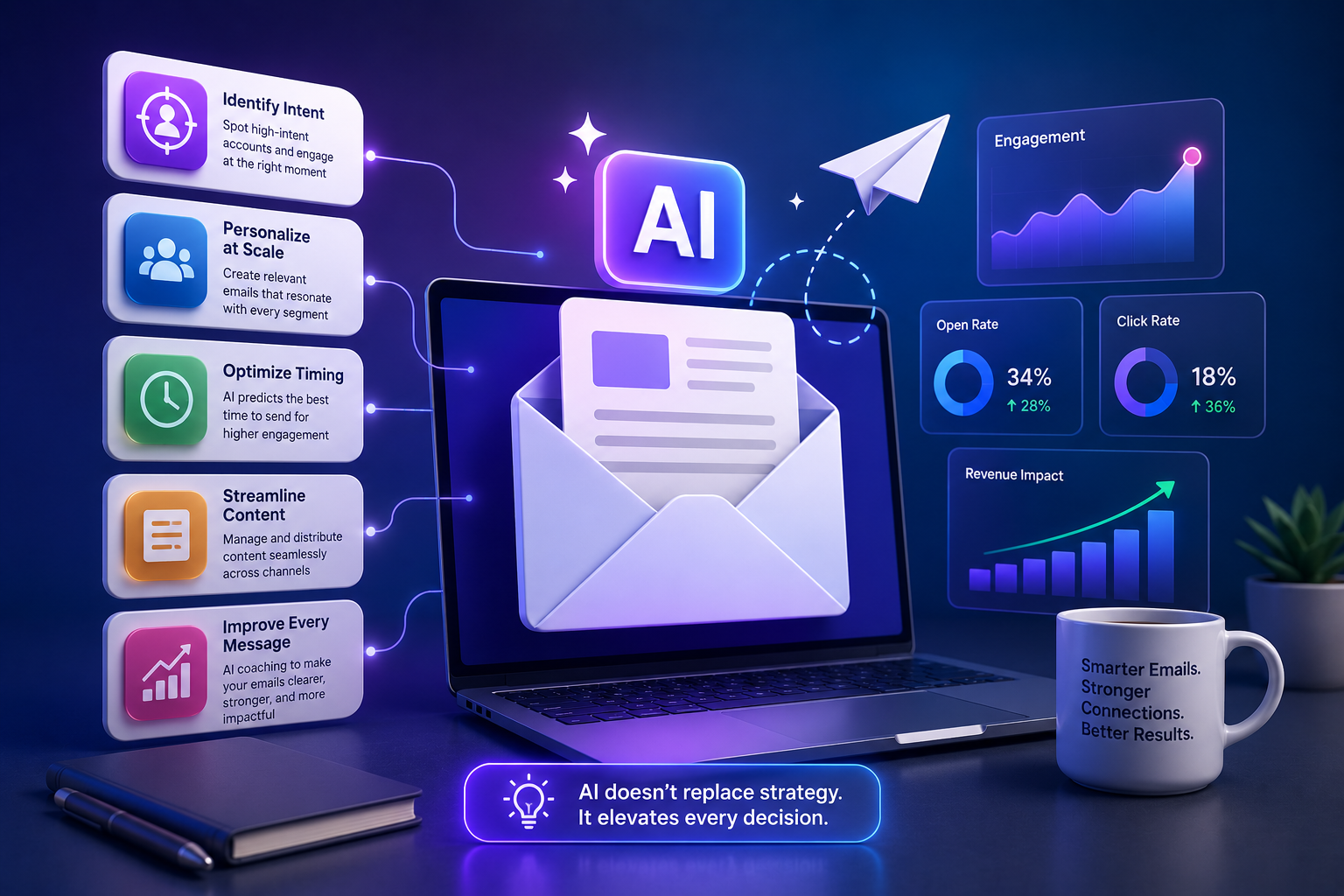
A common thread runs through all five platforms.
They are not focused solely on generating email copy.
Instead, they address broader challenges:
- Understanding buyer intent
- Improving timing and relevance
- Streamlining content operations
- Enhancing personalization
- Connecting engagement to revenue outcomes
This reflects a larger shift happening across B2B marketing. According to recent industry research, AI adoption among B2B marketers has become nearly universal, but organizations are increasingly looking beyond productivity gains toward systems that improve decision-making and customer engagement.
The most successful email programs in 2026 will likely belong to organizations that use AI not as a replacement for strategy, but as a tool for delivering more meaningful experiences throughout the buyer journey.
For decision-makers evaluating marketing investments, that distinction may matter more than any new feature or automation capability.